
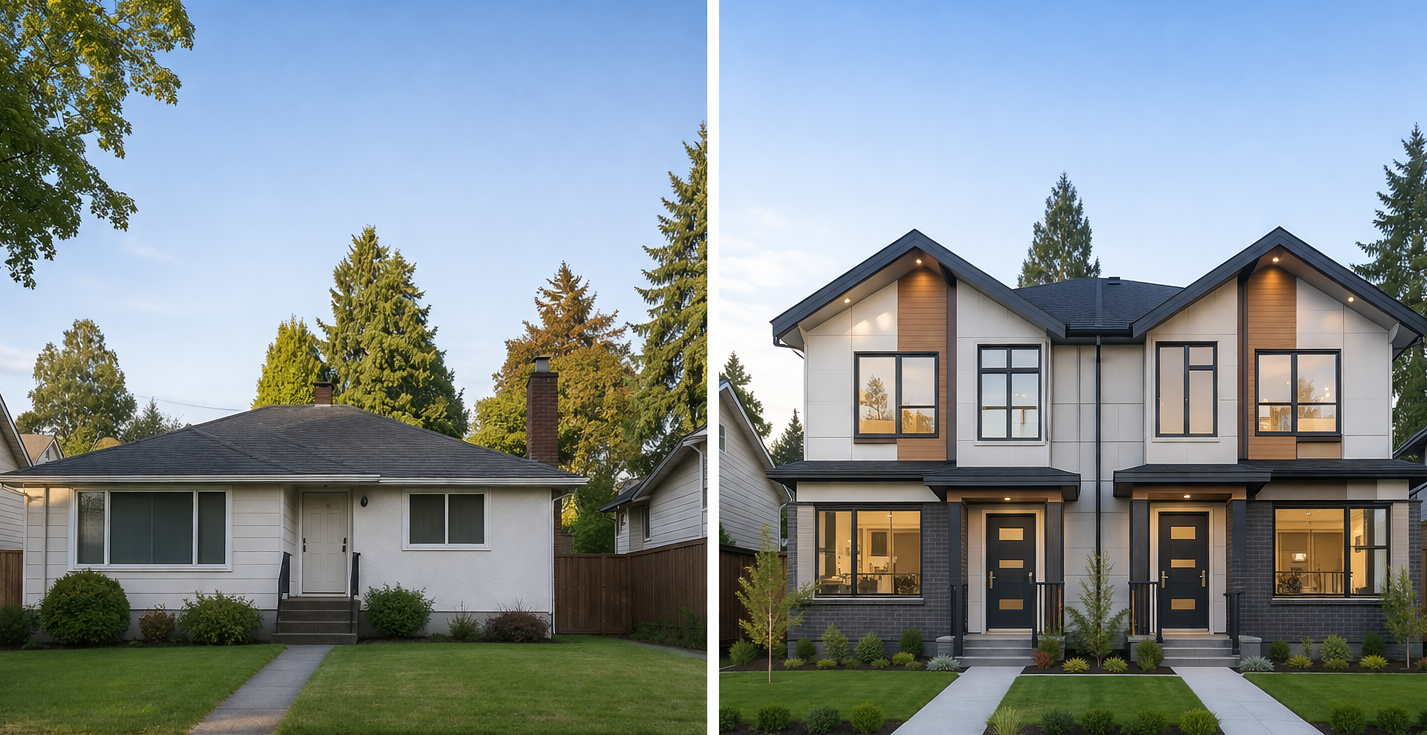
Short answer: Probably.
But the better question is: should you?
Following the adoption of Bill 44, many residential properties across British Columbia are no longer limited to a single detached home. Depending on lot size, location, and servicing, properties that were once limited to one house may now support three to six dwelling units.
The End of Single Family Zoning in BC?
In 2023, the Province of British Columbia introduced Bill 44, requiring municipalities to permit small-scale multi-unit housing in areas that were traditionally reserved for single family detached homes. This was a big change.
Many property owners across BC are now entitled to develop multiple dwelling units (e.g. basement suites, garden suites, duplexes, triplexes etc.) in what were once traditional single family neighbourhoods.
There are a few important caveats to Bill 44. These requirements generally apply to municipalities with populations over 5,000 and to properties that are serviced with municipal water and sewer.
Within such parameters, local governments were required to update their zoning bylaws, and most have now done so.
The result: most municipalities can no longer restrict areas to single family detached homes.
Step one is to check to the City’s updated zoning bylaw.
What This Looks Like on the Ground
Implementation of Bill 44 occurred at the municipal level. Because the policy direction came from the province, the allowed densities and unit counts across many municipalities are similar. Here are some examples.
In the City of Surrey, for example, the R3 Zone (Urban Residential) now allows up to four units on many standard lots, and up to six units near frequent transit areas. The City states these units can take the form of duplexes, traditional houses with suites, or even “houseplexes“.
In the City of Burnaby, traditional single-family zoning has been replaced with “Small-Scale Multi-Unit Housing Districts”, signaling a clear shift. You don’t even see the term Single Family House in this section of the bylaw. Burnaby has provided clear diagrams to help show the housing types that are now allowed.
In interior municipalities like the City of Kamloops, the same provincial requirements apply. However, they have chosen to make very clear in their zoning bylaw that servicing constraints (ex. such as water for fire fighting) may restrict unit counts.
So what does this actually mean for your property?
So, Can You Build a Duplex?
In many cases, zoning will now say yes. But zoning is only the first layer of analysis.
A more complete answer requires looking at how the rules interact with your specific property.
Other City Policies to Consider
Even though municipalities were directed to ensure they didn’t implement other restrictions to undermine the intent of the Provincial legislation, every property is unique. Setbacks, height limits, floor space ratios, and parking requirements all shape what can realistically be achieved on a property.
There are also overlay policies to consider. For example, a property located on a steep slope may fall within a Development Permit Area. That doesn’t prevent development, but it introduces additional steps, design constraints, and costs that need to be factored into your decision.
Environmental and heritage policies are also items that need to be reviewed in detail.
Title Constraints: The Hidden Layer
One of the most common surprises for developers planning a duplex comes from the legal title.
Across BC, many existing single family properties are subject to covenants and building schemes that were registered on title at the time of the original subdivision. These covenants can restrict secondary suites, limit building size, or impose design requirements that make additional units difficult to achieve.
Unlike zoning, these are private legal restrictions. They remain in force and stay with the property, despite the zoning allowances, unless they are formally discharged. This is often a negotiated process involving legal work and, in many cases, consent from neighbouring property owners.
Easements and rights-of-way can also reduce the usable portion of a site, which becomes more impactful as you try to fit additional units onto the property.
Servicing Can Make or Break a Project
Servicing is one of the most underappreciated factors in small-scale development.
While Bill 44 assumes that qualifying properties are connected to municipal infrastructure, the reality is that capacity and configuration still matter.
The City may have updated their zoning bylaw to allow multiple units for properties where upgrades to infrastructure are still required. This doesn’t mean you can’t build a duplex, but understanding the costs and timeline to upgrade becomes paramount.
On properties still serviced by septic systems, the path to adding units can be more complicated, and in some cases, not viable.
Every Site Is Different
Beyond policy and servicing, the physical characteristics of the property play a major role.
Slope, lot width, and access all influence what can realistically be designed and built. A narrow lot with significant grade change may technically permit a duplex but result in an inefficient or costly layout. Conversely, a flat corner lot may unlock design options that significantly increase value.
Two properties with the same zoning can have very different development outcomes.
Allowed vs. “Best” Use
This is where a strategic lens matters.
A duplex may be permitted, but it may not represent the highest and best use of the property.
In some cases, a four-unit configuration, or even a single-family home with a suite, can produce a better financial outcome depending on construction costs, market demand, and buyer preferences.
Ownership structure also plays a role a needs to be considered. Duplexes in BC are often stratified (BCs method of creating separately owned condominiums), which may improve marketability but also introduces additional steps and costs.
The key is understanding what can be built, modeling the scenarios and running the numbers.
The Key Takeaway
The recent zoning changes across British Columbia have opened the door to more housing options. But unlocking that value requires more than confirming what’s allowed in the zoning.
It requires understanding the interaction between policy, title constraints, servicing, site conditions, and market demand…and making decisions that align with your specific goals.
Many people assume that more density automatically means more value. There’s a lot more to it than that.
In practice, the best outcomes come from a careful balance of what is allowed, what is feasible, and what the market actually supports.
A Smarter Way to Evaluate Your Property’s Development Potential
If you’re considering building a duplex, or exploring other options, a structured due diligence process makes a significant difference.
At a minimum, you should be systematically reviewing zoning, title, servicing, site conditions, and financial feasibility before making any decisions. Missing one of these layers can lead to costly surprises later on.
If you don’t already have a framework for this, using a detailed development checklist helps ensure you’re asking the right questions at the right time and making decisions with a full picture of the opportunity.
Could Your Project Benefit From Expert Guidance?
If you’d like confidence before moving forward, SiteMentor Development Consultants provide industry-best development feasibility reports that identify what your property can realistically support, highlights potential constraints, and helps you determine the development strategy that makes the most sense for your goals.


